How to Solve Zip Puzzles: 7 Tips for Drawing the Perfect Path

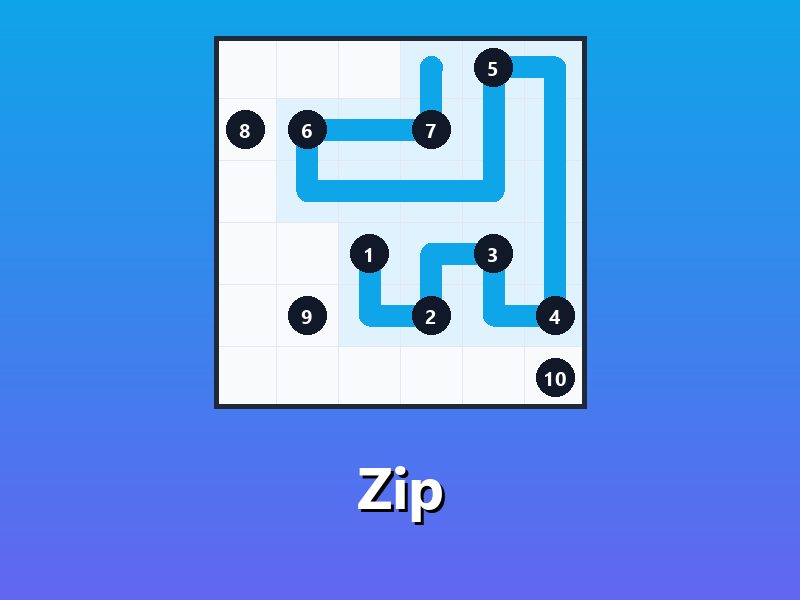
Zip has the simplest rules of any daily puzzle: draw one line from 1 to the highest number, passing through the numbers in order and visiting every cell exactly once. The challenge is that it's easy to paint yourself into a corner, reach the last number and discover a few cells you forgot. These seven tips will help you draw the perfect path first time more often.
Zip rules in brief
- Start on 1 and finish on the highest number.
- Pass through the numbers in order.
- Move only up, down, left or right.
- Visit every cell exactly once.
Practise as you read with our free Zip puzzle: there's a new daily puzzle (6×6 on weekdays, 7×7 at weekends) plus unlimited 5×5 to 7×7 grids.
1. Look before you draw
Before touching the grid, trace the rough order of the numbers with your eyes. Where is 2 relative to 1? Does the route from 3 to 4 have to cross the whole board? A few seconds of planning avoids most dead ends.
2. Deal with corners early
A corner cell has only two neighbours. Unless the path starts or ends there, the line must enter through one neighbour and leave through the other. That fixes two steps of the route straight away, so decide how each corner will be visited before you get near it.
3. Watch for cells with only two ways in
The same logic applies anywhere: if an empty cell has only two empty neighbours left, the path must pass through it using exactly those two. If it has only one, it must be the end of the line, which is only possible for the final number. Spotting these "forced" cells keeps you out of trouble.
4. Don't cut the board in two
If your line splits the empty cells into two separate areas, you will only be able to finish one of them. Before committing to a move along the middle of the board, check that the remaining empty cells still connect to each other and to the numbers you still need to reach.
5. Hug the edges
Cells along the border are the ones most often left behind. When your route passes near an edge, it's usually safest to sweep along it rather than leave a thin strip of cells you would have to come back for later.
6. Snake through open areas
When you have a big open area to fill between two numbers, move back and forth in a "snake" pattern, row by row or column by column. It covers every cell without leaving gaps, and it's easy to adjust at the end so you leave from the right spot.
7. Work backwards from the last number
The final number is the end of the line, so its neighbouring cells have to be filled earlier in the path. Thinking about how the line arrives at the last number (and at the number before it) often reveals which areas must be covered first.
When you go wrong
Mistakes are cheap in Zip: drag your line backwards to undo steps, or tap any cell on your line to cut it back to that point. If you're stuck, a hint removes any wrong part of the line and draws the next few correct steps, so you can see where your plan went astray.
Enjoyed Zip? Try our other daily logic puzzles, Queens and Tango, and read how to solve Queens puzzles.